
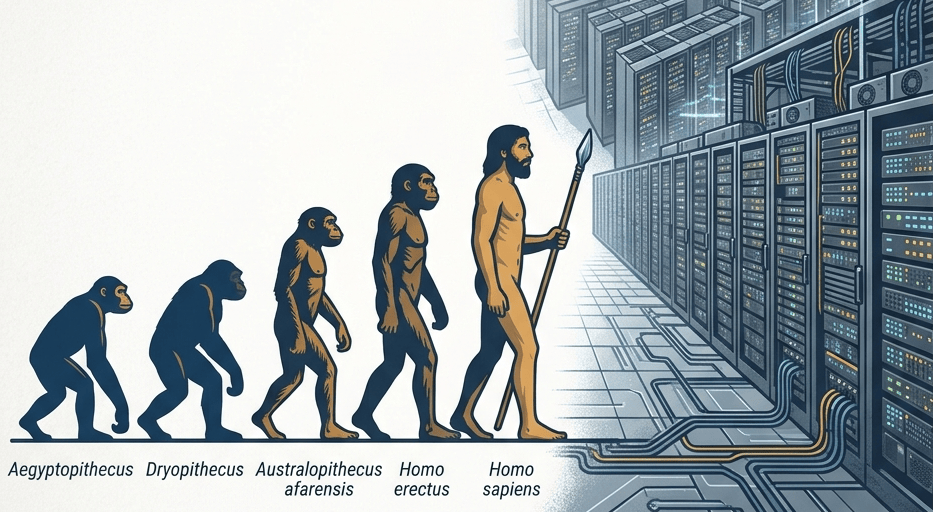
In 1917 Sigmund Freud wrote Eine Schwierigkeit der Psychoanalyse (A Difficulty in the Path of Psycho-Analysis). The article was Freud’s attempt to explain why his psychoanalytic theory was controversial. He said there is something about psychoanalysis that “alienates the feelings of those who come into contact with it, so that they become less inclined to believe in it.” That something, according to Freud, was that it inflicts a “severe blow” on “the universal narcissism of men, their self-love.”
According to Freud, humanity had suffered three such blows, now commonly referred to as “humiliations.” Freud’s three humiliations of humanity were:
- Cosmological humiliation: the fact that humanity is not at the center of the universe.
- Biological humiliation: the fact that humans are not above or outside the animal kingdom.
- Psychological humiliation: the fact that there is a large difference between how we think our minds work and how they actually work.
In Freud’s words, “the life of our sexual instincts cannot be wholly tamed, and that mental processes are in themselves unconscious and only reach the ego and come under its control through incomplete and untrustworthy perceptions.” “No wonder, then, that the ego does not look favorably upon psycho-analysis and obstinately refuses to believe in it.”
Here Freud has performed two tricks at once. He’s placed himself on a pedestal with Copernicus and Darwin, and he has explained why his detractors don’t want to believe in psychoanalysis. It’s not because psychoanalysis is wrong, it’s because it threatens their self image.
I won’t go into the problems with psychoanalysis. Click here to enter that rabbit hole.
Despite Freud’s sleight of hand, there is some truth to the idea that the first two humiliations challenged not just people’s scientific understanding of the universe and the animal kingdom, but also their identities as God’s special creatures.
Freud gave himself much too much credit, but the idea that our perceptions, memories, and reasoning are not fully under our conscious control is largely correct. Our perceptions depend on the task we’re focused on, our memories are reconstructions, and our explanations for why we did what we did are often post hoc rationalizations. The third “humiliation” is less humiliating largely because so few people understand it. One goal of the Behrens Science Museum is to teach visitors how the tools of science are needed to compensate for the limitations revealed by the third humiliation.
Today, we’re in the midst of a fourth humiliation. Intellectual humiliation. Intelligence is the defining feature of humanity. It is the reason humans are the Earth’s apex predator. It is a point of pride, prestige, and status in society. Perhaps no humiliation will be harder to stomach than this one. But the list of intellectual tasks that people can do that Claude and ChatGPT cannot keeps getting shorter.
People often confidently protest that AI isn’t conscious, or that AI doesn’t really understand, or that AI is “just” a next-token generator. These statements may or may not be true. But people who are otherwise quite careful—even skeptical—are sometimes surprisingly willing to assert them as facts. I think much of their certainty reflects the fear that we are losing our intellectual superiority.
Welcome to the fourth humiliation.

